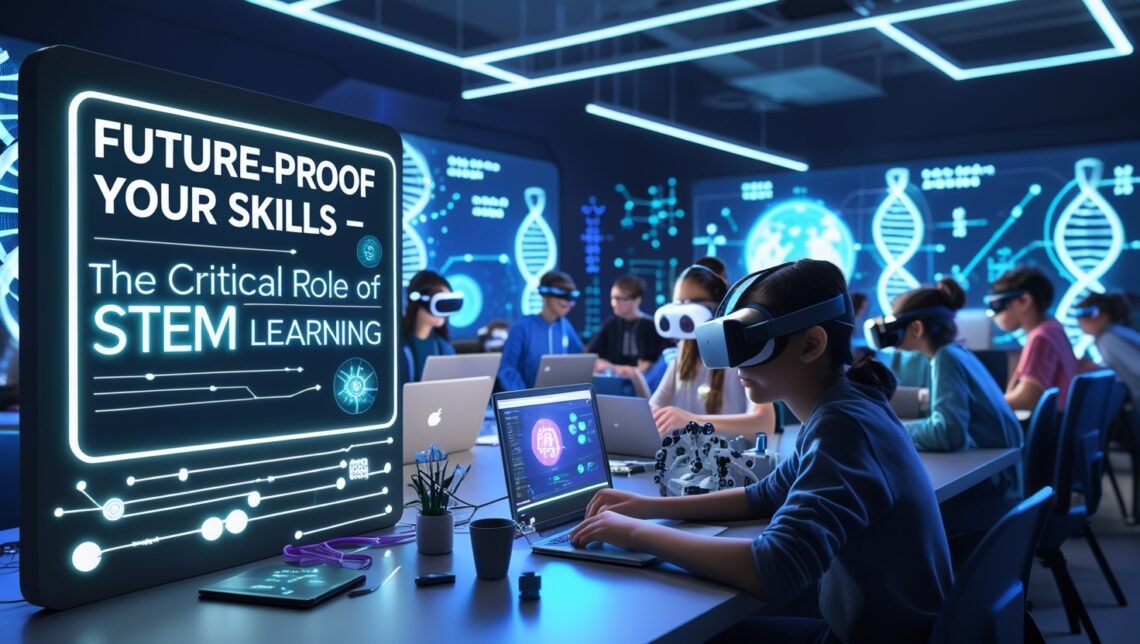
Today technology is progressing so fast that every few months there are new tools, systems and software introduced. In such an environment only those people move ahead who are ready to learn new skills. Future-proofing means developing your skills in a way that they remain relevant in the future. The most important aspect of this is that you learn the skills that will be in demand throughout the era and STEM learning is ahead of all of them.
STEM stands for Science, Technology, Engineering, and Mathematics. These fields not only open new avenues of employment but also give you critical thinking, problem-solving solving and analytical mindset. Today’s job market does not just look at degrees but values practical skills and adaptability more. People with STEM backgrounds find it easier to adopt new technologies and feel confident in the digital world.
Future-proof skills also mean that you develop capabilities that are useful in the era of automation and AI. STEM learning gives you an edge that helps you remain competitive in the market. Every branch should make STEM education a part of it to ensure their career is safe, whether they are students or working professionals.
What is STEM and Why It’s at the Core of Future Jobs:
STEM stands for Science, Technology, Engineering, and Mathematics. These four fields are the foundation of the modern world. Everything we use daily, like mobile apps, electric cars, health devices, or space exploration, is a result of these STEM skills. STEM education teaches humans not only theory, but also how to find solutions to real-world problems. When you learn in the STEM field, you develop critical thinking, logical reasoning, and research skills, which are very important for any profession.
Today’s job market is facing rapid change. Traditional jobs are gradually disappearing, and new roles are being created where automation, AI, and data science are being used. In such a situation, STEM knowledge prepares you for those roles that will be in greater demand in the future. For example, the demand for data analysts, software developers, robotics engineers, and biotech scientists is increasing.
Not just engineers or scientists, the role of STEM has increased in every field technology has been integrated into finance, marketing, education, even fashion. Hence STEM is not just a career choice but has become a necessity of the future. People who adopt STEM education not only upgrade their skills but also secure their career for long-term success.
How STEM Skills Prepare You for Automation and AI:
Today’s digital world is filled with automation and artificial intelligence (AI). Companies are using systems that perform repetitive tasks on their own. This is eliminating many traditional jobs. But STEM skills prepare you to face this challenge. When you know programming, data analysis or machine learning, you are not only afraid of these systems, but also become capable of creating, understanding, and using them.
STEM skills give you logical thinking and a structured problem-solving approach. If you learn software development, you can design automation tools yourself. If you know AI and Data Science, you qualify for the most in-demand jobs of the future. STEM takes you towards innovation, where you become a part of automation, not its victim.
Apart from this, STEM education teaches you adaptability. When new tools or programming languages arrive, you can easily understand and use them. This gives you the advantage of continuously evolving while others lose their jobs with the advent of new systems.
The future of automation and AI is bright, but only for those who understand this wave and become a part of it. STEM skills teach you to ride on the same wave.
The Global Demand for STEM Professionals:
The demand for STEM professionals is increasing every year across the world. In developed countries like USA, Canada, UK and Germany, thousands of jobs become vacant every year but qualified people are not available to fill them. The reason for this is that technology is growing so fast that the educational systems are not able to prepare skilled people at the same speed. This gap has become a golden opportunity for STEM professionals.
From healthcare to space research, there is a need for STEM experts in every field. For example, scientists are needed to develop new treatments in biotechnology, cybersecurity, and data engineers are in demand in the IT sector, and environmental engineers are needed to find solutions to climate change. Every company wants people who understand and can apply the technologies of the future.
Because of this demand, STEM jobs are not only secure but their salaries are also have high. Employers give more priority to people with a STEM background because they know that these people can bring innovation. Doors are always open for STEM people in freelancing, remote work and global job markets. If you want your skills to be useful across the world, then STEM education is a powerful way. It makes you not a local but a global player.
Incorporating STEM Learning at All Education Levels:
STEM learning should not be limited to universities, it should be incorporated at every education level. When people are introduced to science, technology, engineering, and mathematics from childhood, their minds naturally develop towards problem-solving and logical thinking. In primary school, STEM can mean basic experiments, coding games, and math puzzles. This increases the curiosity of students and they find it fun to learn.
At the middle and high school level, STEM concepts can be taught in a more structured way such as robotics, computer programming, and lab-based science projects. Teachers should be trained to inculcate a sense of research in students and teach them practical skills. The future of every student is digital, so they should familiarize themselves with the tools that will become a part of their career tomorrow.
STEM education in colleges and universities should be aligned with the industry. There should be programs that focus on solving real-world problems and provide internships and research opportunities to students. The government and the private sector should come together to upgrade the STEM curriculum so that the new generation is ready for the future.
When society prioritizes STEM education, not just the students but the country’s future is also secured. STEM is essential at every level if we want to move ahead in this technology-driven world.
Conclusion:
Today’s time is taught that only those people are successful who upgrade their skills with time. STEM education is not just an academic choice, but a long-term investment that secures your future. Whether you are a student, a job holder, or a business owner, basic knowledge of STEM will help you in every field. You will be able to understand new tools, create new ideas, and feel confident in the digital world.
STEM fields not only provide employment but also take you towards innovation and leadership. When you start understanding advanced topics like AI, data science, or robotics, you become an industry leader. You start creating your solutions, rather than just following someone else’s given methods.
The purpose of this blog is that everyone understand the importance of STEM and choose a progressive learning path for themselves. You should hone your skills by using certification courses, online learning platforms, and workshops. The future is unpredictable, but one thing is clear – STEM skills can prepare you for every challenge. Today is the time for action. Investing in STEM means investing in your future. This investment is never wasted.
FAQs:
- What does STEM stand for and why is it important for the future?
STEM stands for Science, Technology, Engineering, and Mathematics. These four areas form the foundation of modern innovations like AI, robotics, space tech, and healthcare advancements. As the world becomes more digital and automated, STEM education helps individuals develop critical thinking, problem-solving, and logical reasoning skills that are essential for future jobs. - How can STEM skills protect my job from automation and AI?
Automation and AI are replacing many traditional jobs. However, if you have STEM skills such as programming, data analysis, or machine learning, you can create, manage, and improve such systems rather than being replaced by them. STEM education equips you to be adaptable and innovative, making you future-proof in the job market. - Is STEM only for engineers and scientists?
No, STEM is no longer limited to just engineers and scientists. It is now integrated into every field including finance, marketing, education, and even fashion. Basic STEM knowledge helps in understanding technology-driven systems and solving complex problems in any industry. - At what education level should STEM learning start?
STEM education should begin as early as primary school through simple coding games, math puzzles, and science experiments. As students progress to middle and high school, structured programs like robotics, programming, and lab projects should be introduced. At the college and university level, education should align with real-world industry needs through internships and applied research. - What are the global opportunities for STEM professionals?
There is a high global demand for STEM professionals, especially in countries like the USA, UK, Canada, and Germany. Fields like biotech, cybersecurity, data science, and environmental engineering are actively hiring, often offering higher salaries and job security. STEM skills also open doors for freelancing, remote jobs, and international careers.